How Bankruptcy Works in Texas: Chapter 7 vs Chapter 13 – 7 Essential Differences
Learn how bankruptcy works in Texas. Compare Chapter 7 vs Chapter 13, understand eligibility requirements, and discover which bankruptcy option is right for you.
Introduction
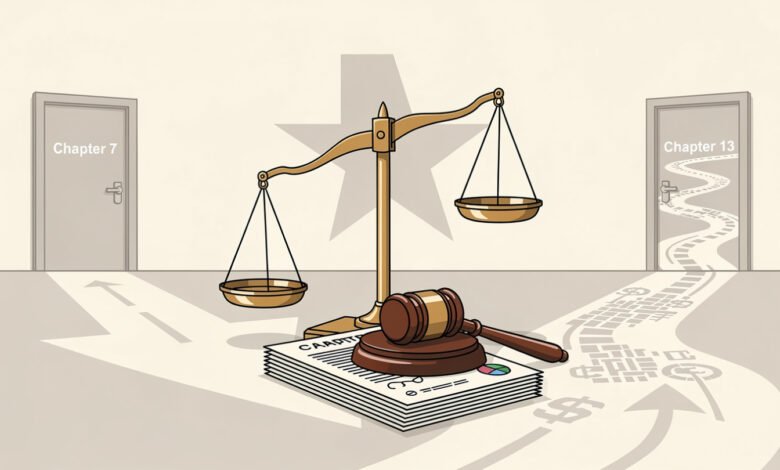
How bankruptcy works in Texas depends on which bankruptcy chapter you choose. For many Texans overwhelmed by debt, filing for bankruptcy in Texas offers a legal pathway to financial recovery. But there’s a critical decision point: should you file Chapter 7 bankruptcy or Chapter 13 bankruptcy?
The difference between these two bankruptcy options is profound. Chapter 7 bankruptcy, often called liquidation bankruptcy, wipes out most unsecured debts within months. Chapter 13 bankruptcy, also known as a reorganization bankruptcy, creates a repayment plan lasting three to five years. Your choice affects everything—how quickly you get relief, what assets you keep, and how long the filing stays on your credit report.
Texas law provides some of the nation’s most generous bankruptcy exemptions, which protect your home, vehicle, and personal property from creditors. But understanding how bankruptcy works in Texas means knowing these protections inside and out. The means test is another critical element that determines whether you even qualify for Chapter 7 bankruptcy. And once you file, the automatic stay immediately halts creditor collection efforts—no more calls, no more wage garnishment.
This guide breaks down bankruptcy in Texas into clear, actionable sections. You’ll learn how each bankruptcy chapter operates, who qualifies for each option, what happens to your assets, how long the process takes, and what the long-term consequences are. Whether you’re facing foreclosure, dealing with credit card debt, or drowning in medical bills, understanding how bankruptcy works is your first step toward taking back control of your financial life.
What Is Bankruptcy and Why Texans File
Bankruptcy is a federal legal process that allows individuals to address overwhelming debt through two main pathways: Chapter 7 bankruptcy and Chapter 13 bankruptcy. When you file for bankruptcy in Texas, you invoke federal law protections that immediately halt creditor collection efforts and provide a structured process for managing your debts.
People file for bankruptcy in Texas for many reasons. Medical emergencies often trigger bankruptcy filings—a single hospitalization can create $50,000 or more in bills. Job loss, business failure, divorce, and accident injuries are other common catalysts. By the time many Texans consider bankruptcy, they’re facing:
- Constant collection calls and letters
- Wage garnishment reducing their paychecks
- Threats of foreclosure or vehicle repossession
- Mounting interest and penalties making debts grow faster than they can pay
- Credit damage that affects employment and housing options
Bankruptcy in Texas isn’t about giving up. It’s a strategic reset designed by Congress to give honest debtors a fresh start. The process is regulated by federal law but shaped by Texas-specific exemptions that are among the most protective in the nation. When you file for bankruptcy, you’re using the legal system exactly as intended—to regain control and move forward financially.


Chapter 7 Bankruptcy: The Fresh Start Option
Chapter 7 bankruptcy is the most common bankruptcy option for individuals, representing roughly 70% of all personal bankruptcy filings. It’s often called liquidation bankruptcy because it potentially involves selling non-exempt assets. But here’s the reality in Texas: most people who file Chapter 7 bankruptcy keep everything they own.
How Chapter 7 Bankruptcy Works
When you file Chapter 7 bankruptcy in Texas, several things happen in quick succession. First, an automatic stay is triggered instantly—this is a court order that stops creditors from calling, texting, filing lawsuits, or continuing collection efforts. The automatic stay gives you breathing room immediately.
Next, you work with a bankruptcy trustee—a court-appointed official who reviews your case. The trustee’s job is to identify any non-exempt assets that can be liquidated to pay creditors. In Texas bankruptcy, generous state exemptions often mean there’s nothing to liquidate. Texas allows:
- An unlimited homestead exemption for your primary residence (up to 10 acres in urban areas or 100-200 acres rural)
- A complete exemption for one vehicle per person in the household
- Up to $100,000 in personal property for families
- Complete protection for retirement accounts like 401(k)s and IRAs
The entire Chapter 7 bankruptcy process typically wraps up in three to six months. At the end, you receive a discharge—a court order eliminating your legal obligation to pay most unsecured debts. After your bankruptcy discharge, creditors can no longer pursue collection.
What Debts Chapter 7 Bankruptcy Eliminates
Chapter 7 bankruptcy in Texas discharges most unsecured debts:
- Credit card debt
- Medical bills
- Personal loans
- Utility bills
- Deficiency balances from repossessed vehicles
What Chapter 7 bankruptcy does NOT discharge:
- Child support and alimony (never discharged)
- Most student loans (rarely discharged)
- Recent taxes and tax penalties
- Criminal fines and restitution
- Debts incurred through fraud
Chapter 7 Bankruptcy Eligibility: The Means Test
To qualify for Chapter 7 bankruptcy in Texas, you must pass the means test. This is a federally mandated calculation that compares your income to the Texas median income for your household size. As of 2026, the Texas median income for a single person is approximately $65,123 annually, rising to over $135,000 for larger families.
How the means test works:
If your monthly income falls below the median for your household size, you automatically qualify for Chapter 7 bankruptcy in Texas—the means test is essentially passed.
If your income exceeds the median, you must complete a detailed analysis showing your reasonable monthly expenses and disposable income. The bankruptcy trustee calculates whether you have money left over each month to repay debts. If your projected disposable income over 60 months is below $7,475, you may still qualify for Chapter 7 bankruptcy.
The means test isn’t designed to exclude people struggling financially—it ensures that Chapter 7 bankruptcy goes to those who truly cannot afford to pay their debts, not those who simply don’t want to.
Timeline for Chapter 7 Bankruptcy
The Chapter 7 bankruptcy process moves relatively quickly:
- File your petition – Your bankruptcy attorney prepares and files all required forms with the court
- Automatic stay takes effect – Creditor collection efforts stop immediately
- Creditors meeting (341 meeting) – Occurs 21-40 days after filing; the trustee reviews your case
- Discharge order – Typically issued 60-90 days after the creditors meeting
- Case closed – Usually 3-6 months from filing to complete resolution
Chapter 13 Bankruptcy: The Repayment Plan Option
Chapter 13 bankruptcy is sometimes called a “wage earner’s plan” or reorganization bankruptcy. Instead of eliminating debts, Chapter 13 bankruptcy restructures what you owe through a repayment plan spanning three to five years. If you want to keep property that wouldn’t be protected in Chapter 7 bankruptcy, or if you earn too much to qualify for Chapter 7, then Chapter 13 bankruptcy becomes your path forward.
How Chapter 13 Bankruptcy Works
When you file Chapter 13 bankruptcy in Texas, you propose a repayment plan to the court showing how you’ll pay creditors over time. The automatic stay still takes effect, stopping collection efforts immediately. But unlike Chapter 7 bankruptcy, you’re not liquidating assets—you’re proposing to pay.
A bankruptcy trustee is appointed to oversee your case, collect your monthly payments according to the repayment plan, and distribute funds to creditors according to the court’s priorities. Your payments go to the trustee (who withholds a 10% fee) and the remainder goes to your creditors.
Chapter 13 Bankruptcy Repayment Plans
The repayment plan in Chapter 13 bankruptcy is structured carefully. You propose payments you can realistically make each month. These payments must cover:
- All arrearage (missed payments on secured debts like mortgages and car loans)
- Priority claims (child support, alimony, recent taxes)
- Unsecured debts (credit cards, medical bills, personal loans) receive whatever’s left
At the end of your Chapter 13 bankruptcy plan—whether 36 or 60 months—any remaining eligible unsecured debt is discharged. You’re released from legal obligation to pay it.
Chapter 13 Bankruptcy Eligibility
Chapter 13 bankruptcy in Texas has different requirements than Chapter 7 bankruptcy:
- No means test required (high earners can file Chapter 13 bankruptcy even if they fail the means test)
- Must have regular income sufficient to support the repayment plan
- Unsecured debt cannot exceed $465,275 (adjusted annually)
- Secured debt cannot exceed $1,395,875 (adjusted annually)
Most Texas residents satisfy these debt limits. The key requirement is demonstrating that you have reliable income to make repayment plan payments.
Chapter 13 Bankruptcy Advantages
Chapter 13 bankruptcy shines in specific situations:
Stopping Foreclosure: If you’re behind on mortgage payments, Chapter 13 bankruptcy lets you catch up over the life of your repayment plan. The automatic stay halts foreclosure immediately, giving you time to reorganize.
Preventing Repossession: Similarly, if your car is at risk of repossession, Chapter 13 bankruptcy stops it and allows you to keep the vehicle while catching up through your repayment plan.
Protecting Co-Signers: In Chapter 7 bankruptcy, co-signers remain liable. In Chapter 13 bankruptcy, the repayment plan can protect co-signers from creditor pursuit.
Keeping Non-Exempt Assets: If you have property with value exceeding Texas bankruptcy exemptions, Chapter 13 bankruptcy lets you keep it by paying the non-exempt value through your repayment plan.
Timeline for Chapter 13 Bankruptcy
Chapter 13 bankruptcy takes longer than Chapter 7 bankruptcy:
- File your petition – Submit your repayment plan and financial disclosures
- Automatic stay takes effect – Stops collection efforts
- 341 meeting – Creditors meeting 21-40 days after filing
- Repayment plan confirmation – Court approves your plan (usually 30-60 days)
- Make payments – Typically for 36-60 months (3-5 years)
- Final discharge – Remaining eligible debts eliminated after plan completion
- Case closes – Usually 3-5 years from filing
7 Key Differences Between Chapter 7 and Chapter 13 Bankruptcy
Understanding how Chapter 7 bankruptcy and Chapter 13 bankruptcy differ helps you choose correctly. Here are the essential distinctions:
1. Speed to Debt Elimination
Chapter 7 bankruptcy offers fast relief—usually 3-6 months from filing to discharge. Chapter 13 bankruptcy requires 3-5 years of payments before discharge. If you need immediate relief from creditor action, Chapter 7 bankruptcy provides it faster.
2. Asset Liquidation
Chapter 7 bankruptcy potentially involves selling non-exempt assets to repay creditors, though Texas exemptions usually protect everything. Chapter 13 bankruptcy never liquidates assets. You keep everything and pay through your repayment plan. If asset retention is paramount, Chapter 13 bankruptcy offers more certainty.
3. Eligibility Requirements
Chapter 7 bankruptcy requires passing the means test—income must be below state median or expenses must demonstrate inability to repay. Chapter 13 bankruptcy has no means test—anyone with regular income and under debt limits can file. High earners generally can’t file Chapter 7 bankruptcy but can file Chapter 13 bankruptcy.
4. Debt Elimination vs. Reorganization
Chapter 7 bankruptcy eliminates unsecured debts entirely (with narrow exceptions). Chapter 13 bankruptcy reorganizes debts, requiring you to pay some or all of what you owe through your repayment plan. The philosophical difference is crucial: Chapter 7 bankruptcy is a true fresh start, while Chapter 13 bankruptcy is debt restructuring.
5. Foreclosure and Repossession Protection
Chapter 7 bankruptcy’s automatic stay stops foreclosure temporarily but doesn’t help you catch up on missed payments—foreclosure can resume after the stay expires. Chapter 13 bankruptcy lets you catch up on arrearages through your repayment plan, permanently stopping foreclosure if you make payments. For homeowners facing foreclosure, Chapter 13 bankruptcy is often superior.
6. Credit Report Duration
Chapter 7 bankruptcy remains on your credit report for 10 years from the filing date. Chapter 13 bankruptcy remains for 7 years from the filing date. Chapter 13 bankruptcy actually clears from your credit history faster—an advantage for post-bankruptcy credit rebuilding.
7. Cost and Timeline
Chapter 7 bankruptcy typically costs $2,000-$2,500 (including attorney fees and court filing fees around $335). Chapter 13 bankruptcy costs vary based on plan complexity but often run $3,000-$5,000 in attorney fees plus monthly trustee fees (10% of payments). Chapter 7 bankruptcy is cheaper upfront but Chapter 13 bankruptcy spreads costs over years of payments.
Texas Bankruptcy Exemptions: What You Keep
Texas offers remarkably generous bankruptcy exemptions—protections that allow you to keep property despite filing for bankruptcy in Texas. These exemptions significantly affect whether Chapter 7 bankruptcy or Chapter 13 bankruptcy makes sense for you.
Homestead Exemption
Texas allows an unlimited homestead exemption for your primary residence. This is extraordinary compared to most states. You can protect:
- Up to 10 acres in urban areas
- Up to 100-200 acres in rural areas
- Unlimited home equity (no cap on the home’s value)
This means a million-dollar home in Dallas is fully protected in bankruptcy in Texas. The only exception: if the home is used for business purposes, protections may be limited.
Vehicle Exemption
You can exempt one vehicle per person in your household. This protection covers the entire vehicle value—from a $5,000 used car to a $60,000 truck. Everyone in the family can protect one vehicle.
Personal Property Exemption
Texas allows up to $100,000 in personal property exemption for a married couple ($50,000 for individuals). This protects household goods, clothing, jewelry, tools, and other personal possessions.
Retirement and Pension Protection
Retirement accounts are completely protected:
- 401(k) plans
- Individual Retirement Accounts (IRAs)
- Pension plans
- Annuities
These protections exist both in federal and Texas law, so you maintain retirement security through bankruptcy.
Tools and Implements
Tools used in your trade or profession are protected, letting you maintain the ability to earn income after bankruptcy.
The Automatic Stay: Immediate Protection in Bankruptcy
One of the most powerful aspects of filing for bankruptcy in Texas is the automatic stay—an immediate court order that halts virtually all creditor collection efforts. The automatic stay takes effect the moment your bankruptcy petition is filed.
Once the automatic stay is in place, creditors must stop:
- Calling or sending collection letters
- Wage garnishment
- Foreclosure proceedings
- Vehicle repossession
- Utility shutoffs (with limited exceptions)
- Lawsuits and judgments
- Any other collection activity
Violating the automatic stay exposes creditors to sanctions and penalties. This powerful protection is one reason many Texans choose to file bankruptcy in Texas even if they ultimately could negotiate outside of court—the automatic stay alone provides immediate breathing room.
Important note: The automatic stay doesn’t permanently stop foreclosure in Chapter 7 bankruptcy—it merely delays it. If you don’t catch up on mortgage payments, foreclosure can resume after the stay expires. Chapter 13 bankruptcy is different; catching up through your repayment plan can prevent foreclosure permanently.
Choosing Between Chapter 7 and Chapter 13 Bankruptcy
Making the right choice between Chapter 7 bankruptcy and Chapter 13 bankruptcy requires honest assessment of your financial situation. Consider these factors:
Do You Have Regular Income?
If income is unstable or minimal, Chapter 7 bankruptcy is likely better—you can’t sustain a Chapter 13 bankruptcy repayment plan without reliable income. If you have steady paycheck income, you might support Chapter 13 bankruptcy.
What Type of Debt Do You Have?
Primarily unsecured debt (credit cards, medical bills)? Chapter 7 bankruptcy likely works. Significant secured debt (mortgage, car loan) with missed payments? Chapter 13 bankruptcy protects assets and lets you catch up.
Are You Facing Foreclosure or Repossession?
If yes, Chapter 13 bankruptcy is often essential. Chapter 7 bankruptcy won’t save your home or vehicle through permanent catch-up; Chapter 13 bankruptcy will.
Is Your Income Above the Median?
If yes, you likely can’t file Chapter 7 bankruptcy (or only if expenses demonstrate inability to repay). Chapter 13 bankruptcy becomes your option.
Do You Have Non-Exempt Assets?
If you own valuable property beyond Texas exemptions, Chapter 13 bankruptcy lets you keep it through your repayment plan. Chapter 7 bankruptcy could mean liquidation (though rare in Texas).
How Quickly Do You Need Relief?
Chapter 7 bankruptcy provides discharge in months. Chapter 13 bankruptcy requires years of payments. Your urgency matters.
Credit Impact and Recovery After Bankruptcy
Bankruptcy in Texas affects your credit, but the impact is often overstated, and recovery is faster than many assume.
Credit Score Impact
Filing bankruptcy in Texas typically causes a credit score drop of 130-200 points, depending on your starting score. However, once the bankruptcy is discharged, credit improvement begins immediately.
- Chapter 7 bankruptcy: Remains on credit report for 10 years
- Chapter 13 bankruptcy: Remains on credit report for 7 years
Post-Bankruptcy Credit Building
After your bankruptcy discharge:
- Get a secured credit card – Deposit $500-$1,000 and use it for small purchases, paying in full monthly
- Become an authorized user – Ask family with good credit to add you to their accounts
- Use credit reporting tools – Monitoring services (free versions available) track your recovery
- Maintain perfect payment history – Every on-time payment rebuilds credit
- Keep credit utilization low – Use less than 30% of available credit
Most people see credit score recovery to 650+ within 1-2 years of bankruptcy discharge through responsible post-bankruptcy behavior.
Long-Term Benefits
Many Texans report that their credit score actually exceeds pre-bankruptcy levels within 3-4 years because bankruptcy discharge eliminates harmful debt-to-income ratios that previously damaged scores. Once bankruptcy stops showing negative payment history, the low ratio becomes an asset.
Working with a Bankruptcy Attorney in Texas
While you can file bankruptcy in Texas without an attorney, doing so is risky. The process involves complex paperwork, timing deadlines, and strategic decisions. Common mistakes include:
- Incorrectly calculating the means test
- Failing to claim available exemptions
- Missing filing deadlines (which result in case dismissal)
- Improper asset valuation
- Inadequate repayment plan structure in Chapter 13 bankruptcy
A Texas bankruptcy attorney helps you:
- Determine whether Chapter 7 bankruptcy or Chapter 13 bankruptcy is optimal
- Maximize exemptions so you keep everything possible
- Structure your case to achieve your goals
- Represent you at 341 meetings and court hearings
- Navigate automatic stay issues and creditor violations
- Plan post-bankruptcy financial recovery
Bankruptcy Myths vs. Reality in Texas
Myth: Bankruptcy means losing everything.
Reality: Texas exemptions are so generous that most Chapter 7 bankruptcy filers keep their home, vehicles, and retirement accounts.
Myth: You can’t file bankruptcy twice.
Reality: You can file again, but must wait 8 years between Chapter 7 bankruptcy filings or 2 years between other bankruptcy filings.
Myth: Bankruptcy destroys your credit permanently.
Reality: Post-bankruptcy credit recovery is faster than carrying high debt. Many see better credit scores within 2-3 years.
Myth: Filing bankruptcy is a moral failure.
Reality: Bankruptcy is a legal tool provided by Congress. Medical debt, job loss, and divorce are common triggers beyond individual control.
Myth: All debt disappears in bankruptcy.
Reality: Student loans, child support, and certain taxes rarely discharge. Bankruptcy eliminates unsecured debts primarily.
The Bankruptcy Process: Step-by-Step
Step 1: Credit Counseling (Required)
Before filing, complete a credit counseling course from an approved agency (usually 1-2 hours, $50-$150).
Step 2: File Your Petition
Your bankruptcy attorney prepares and files your petition with the appropriate Texas federal court. You’ll file detailed financial schedules listing all assets, debts, income, and expenses.
Step 3: Automatic Stay Takes Effect
Filing immediately triggers the automatic stay. Creditors must cease collection efforts.
Step 4: 341 Meeting of Creditors
21-40 days after filing, you meet with the bankruptcy trustee and creditors (if they attend) to answer questions under oath. This meeting is routine in most cases.
Step 5: Objection Period
Creditors have 60 days to object to your discharge (in Chapter 7 bankruptcy) or contest your repayment plan (in Chapter 13 bankruptcy). Most cases have no objections.
Step 6: Discharge (Chapter 7) or Confirmation (Chapter 13)
Chapter 7: Court issues a discharge order 60-90 days after the 341 meeting.
Chapter 13: Court confirms your repayment plan after objection period (or sooner if no objections).
Step 7: Financial Management Course
After filing, complete a financial management course (usually 2 hours, online, $50-$100).
Step 8: Case Closes
Chapter 7: 3-6 months after filing.
Chapter 13: After final repayment plan payment (3-5 years).
Special Situations: Bankruptcy Variations in Texas
Bankruptcy and Your House
If you’re behind on your mortgage, Chapter 13 bankruptcy is often essential. Your repayment plan lets you catch up on arrearages over time while keeping your home. Chapter 7 bankruptcy provides only temporary protection; foreclosure can resume.
Bankruptcy and Your Car
Similar to home situations, Chapter 13 bankruptcy protects vehicles you want to keep while catching up on missed payments. If your vehicle is current on payments, Chapter 7 bankruptcy usually works fine (and the vehicle is exempt anyway in Texas).
Bankruptcy and Business Debt
If you have personally guaranteed business loans or sole proprietor debt, Chapter 7 bankruptcy typically eliminates this personal liability. However, the business itself may face separate consequences.
Bankruptcy and Taxes
Chapter 7 bankruptcy discharges old taxes (typically 3+ years old) and fraud penalties. Recent taxes and trust fund taxes are not dischargeable. Chapter 13 bankruptcy lets you pay old taxes through your repayment plan.
Conclusion
How bankruptcy works in Texas is fundamentally about two different pathways to financial recovery. Chapter 7 bankruptcy offers a clean slate through debt elimination in months, protected by Texas’s extraordinary exemptions that let most filers keep their homes, vehicles, and retirement. Chapter 13 bankruptcy restructures debt through a repayment plan, stops foreclosure and repossession, and moves faster off your credit report. Choosing between them requires honest assessment of your income, assets, debt types, and goals—and this is where professional guidance becomes invaluable. The automatic stay protects you from creditor harassment regardless of which path you choose, providing immediate relief the moment you file. Texas bankruptcy exemptions are among the nation’s most generous, making bankruptcy in Texas particularly protective for filers. Whether you’re drowning in credit card debt, facing medical bills, dealing with foreclosure, or recovering from business failure, understanding how bankruptcy works empowers you to make informed decisions. The key is acting before debt becomes completely unmanageable—the sooner you file, the sooner you can rebuild your financial life and move forward with confidence.