Victoria Business Structure Options: 5 Powerful Sole Trader vs Company vs Trust Facts You Must Know
Victoria business structure options explained — compare sole trader, company, and trust to make the smartest, most tax-efficient choice for your business in 2026–27.
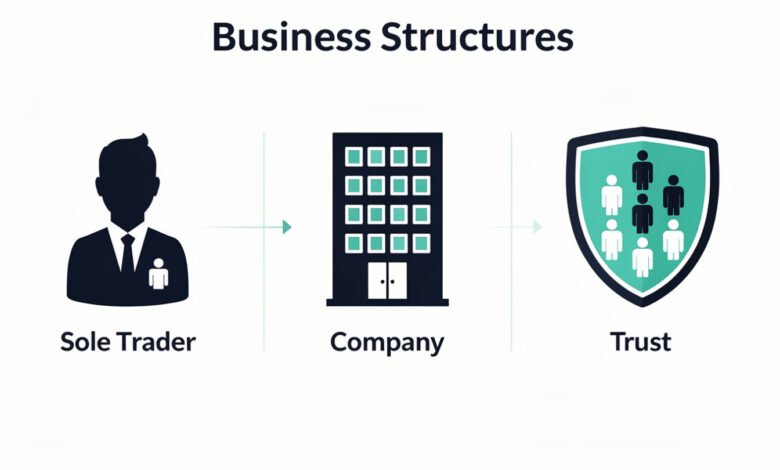
Victoria business structure options are one of the first major decisions you’ll face when starting or growing a business in Victoria. And yet, a surprising number of business owners pick a structure quickly, almost at random, and then spend years either overpaying tax or carrying more personal risk than they need to.
The truth is, the structure you choose affects almost everything: how much tax you pay, whether your personal assets are protected if something goes wrong, how easy it is to bring in a business partner, and what your options look like when you eventually want to sell or hand over the business. Getting it right from the start saves real money and genuine headaches.
This guide breaks down the three most common business structure options in Victoria — sole trader, company, and trust — in plain, practical terms. We’ll look at what each one means, what it costs, how each is taxed, and which type of business owner each structure suits best. Whether you’re a freelancer just starting out, a tradie thinking about going legit, or a family business looking to protect hard-earned assets, this guide has what you need.
Victoria Business Structure Options: An Overview
Before diving into the specifics, it’s worth understanding what we’re comparing. In Australia, the most common business structures are:
- Sole trader — you and the business are legally the same entity
- Company (Pty Ltd) — a separate legal entity with its own tax obligations
- Trust (discretionary or family trust) — a trustee manages assets and income on behalf of beneficiaries
Each sits at a different point on a spectrum of simplicity versus sophistication. A sole trader setup takes an afternoon to register. A company or trust with a corporate trustee can take a few weeks and a decent accountant’s bill. That complexity isn’t always a downside — it often reflects the protections and flexibility those structures offer.
Sole Trader: The Simplest Way to Start
What Is a Sole Trader?
A sole trader is the most basic and most common business structure in Australia. When you operate as a sole trader, you and the business are legally one and the same. There’s no separate legal entity. You control all decisions, keep all profits, and bear all losses personally.
You can still hire staff as a sole trader. You just can’t employ yourself.


Setting Up as a Sole Trader in Victoria
Registration is straightforward:
- Apply for an Australian Business Number (ABN) via the Australian Business Register (free)
- Register your business name with ASIC if trading under a name other than your own (around $44 for one year)
- Register for GST once your turnover hits or is likely to exceed $75,000
That’s largely it. No annual company fees, no corporate compliance obligations.
Tax as a Sole Trader
As a sole trader, your business income is taxed at individual marginal rates. For the 2026–27 financial year, that means:
| Taxable Income | Tax Rate |
|---|---|
| $0 – $18,200 | 0% (tax-free threshold) |
| $18,201 – $45,000 | 16% |
| $45,001 – $135,000 | 30% |
| $135,001 – $190,000 | 37% |
| Over $190,000 | 45% |
Plus the 2% Medicare Levy applies on top.
The key takeaway here: once your net business profit exceeds roughly $135,000, you’re paying tax at 37 cents in the dollar. Over $190,000, it jumps to 45%. That’s a meaningful drag on take-home income compared to the 25% flat rate a small company pays.
Pros of Being a Sole Trader
- Lowest setup cost — virtually free to establish
- Minimal ongoing administration
- Business losses can offset other income (including PAYG income from another job)
- Access to the small business CGT concessions
- Full control with no need to consult shareholders or directors
Cons of Being a Sole Trader
- Unlimited personal liability — if the business is sued or goes into debt, your home, car, and savings are all at risk
- Higher tax rates at higher income levels
- Can be harder to raise finance or attract investors
- Business identity is tied to you personally — harder to sell
Who Should Consider a Sole Trader Structure?
Sole trader suits you if you’re:
- Just starting out and testing a business idea
- Running a low-risk service business (consulting, bookkeeping, graphic design)
- Earning under roughly $80,000 in net business profit
- Not employing staff or carrying significant business debt
Company (Pty Ltd): Separate Legal Entity, Lower Tax Rate
What Is a Pty Ltd Company?
A proprietary limited company (Pty Ltd) is a separate legal entity from its owners. It can own assets, sign contracts, employ staff, and take on debt in its own name. The directors run the company, while shareholders own it — and those can be the same person.
This separation is the most important feature of a company structure. If the business fails, in most cases, creditors can only pursue the company’s assets, not your personal ones (though personal guarantees and director duty breaches are exceptions).
Setting Up a Company in Victoria
The key steps:
- Register the company with ASIC (Australian Securities and Investments Commission) — currently around $597 for a standard Pty Ltd
- Apply for an ABN and Tax File Number (TFN) for the company
- Set up a separate company bank account
- Appoint at least one director (who must be an Australian resident)
Ongoing annual ASIC review fees apply (currently $310 per year). You’ll also need company tax returns lodged separately from your personal return, which adds to your accountant’s bill.
Tax for a Company
Companies that qualify as a base rate entity (turnover under $50 million, with passive income under 80% of total income) pay a flat 25% tax rate on profits. Larger companies pay 30%.
This flat rate becomes genuinely attractive once business profit exceeds around $80,000–$100,000. At that level, keeping money in the company and reinvesting it (rather than paying yourself a big salary) means the retained profits are only taxed at 25%, not 37% or 45%.
When you do take money out — as a salary or dividend — you pay personal tax on that too. But franking credits (imputation credits) prevent double taxation on dividends.
Pros of a Company Structure
- Limited liability protects personal assets
- Flat 25% company tax rate for base rate entities
- More credible with clients, banks, and investors
- Easier to bring in business partners or investors via share issuance
- Business can continue operating regardless of changes in ownership
- Potential for tax deferral by retaining profits inside the company
Cons of a Company Structure
- Higher setup and ongoing costs (ASIC fees, more complex tax returns)
- More compliance obligations — record keeping, financial reporting, director duties
- Losses cannot be distributed to shareholders personally (they stay inside the company)
- Requires more administrative discipline to keep business and personal finances fully separate
Who Should Consider a Company?
A company structure suits you if you’re:
- Generating net profit above $80,000–$100,000 per year
- Operating in a higher-risk industry (construction, professional services, retail)
- Planning to take on employees or business partners
- Looking to grow, attract investment, or eventually sell the business
- Wanting a credible, long-term business structure
Trust: Flexible Income Distribution and Asset Protection
What Is a Business Trust?
A trust is a legal arrangement where a trustee holds and manages assets or business income on behalf of beneficiaries. The most common type used in business is a discretionary trust (often called a family trust), where the trustee has full discretion to decide how income is distributed among beneficiaries each year.
Trusts are not a separate legal entity in the way a company is — the trustee holds legal responsibility. That’s why many trusts use a company as their trustee (a “corporate trustee”), which then provides the liability protection.
Setting Up a Trust in Victoria
Trust setup involves:
- Drafting a trust deed (the legal document governing the trust’s rules)
- Paying stamp duty on the trust deed (in Victoria, typically around $200)
- Registering the trust for an ABN and TFN
- Setting up a trustee (individual or company)
Setup costs vary but typically fall between $1,500 and $3,000 when using a solicitor or accountant, especially if you’re using a corporate trustee.
Tax for a Trust
Trusts are tax transparent — the trust itself doesn’t pay income tax (unless income is left undistributed). Instead, income flows through to beneficiaries who pay tax at their individual rates.
This is where trusts have traditionally been powerful. The trustee can distribute income to family members on lower incomes — a spouse, adult children, or even retired parents — effectively lowering the family’s overall tax bill. This is called income splitting.
For example, if the trust earns $150,000 and distributes $75,000 to each of two adult beneficiaries who have no other income, both stay within lower tax brackets. Without the trust, one person taxed on the full $150,000 would pay significantly more.
Trusts also allow beneficiaries to access the 50% CGT discount when a capital asset is sold after 12 months — an advantage companies don’t pass on.
Important 2026 development: The 2026–27 Federal Budget has proposed a 30% minimum tax on discretionary trust income, effective from 1 July 2028. This would substantially reduce the income-splitting advantage that has made family trusts so popular. The legislation is still being developed, but business owners currently using or considering a trust structure should speak to their accountant about how this may affect their planning.
Pros of a Trust Structure
- Flexible income distribution to minimise the family’s total tax bill
- Strong asset protection — beneficiaries don’t directly own trust assets
- Access to the 50% CGT discount passes through to individual beneficiaries
- Useful for estate planning and passing wealth to the next generation
- Can be effective for family businesses where multiple people contribute
Cons of a Trust Structure
- Higher setup and ongoing costs compared to a sole trader
- More complex to administer, especially at tax time
- Losses cannot be distributed to beneficiaries (they stay inside the trust)
- Undistributed income is taxed at the highest marginal rate (47%)
- The ATO has been increasing scrutiny of trust structures and distributions
- Proposed new 30% minimum tax from 2028 significantly changes the tax economics
Who Should Consider a Trust?
A trust may suit you if you’re:
- Running a family business with multiple adult family members who can be beneficiaries
- Holding investment assets and wanting to manage CGT efficiently
- Looking for asset protection in a higher-risk business or investment environment
- Earning strong income and able to legitimately split it across a lower-income family group
- Planning for long-term succession and wealth transfer
Comparing the Three Structures: A Quick Reference
| Feature | Sole Trader | Company (Pty Ltd) | Trust |
|---|---|---|---|
| Setup cost | Very low (near free) | Moderate (~$600 ASIC) | Moderate–high ($1,500–$3,000) |
| Ongoing costs | Minimal | $310 ASIC fee + accounting | Accounting + trust admin |
| Tax rate | Individual rates (up to 47%) | 25% flat (base rate entity) | Individual rates via beneficiaries |
| Asset protection | None | Strong (limited liability) | Strong (via trustee structure) |
| Income splitting | No | No | Yes (discretionary) |
| Complexity | Very simple | Moderate | High |
| Good for | Early-stage, low-risk | Growth businesses | Family businesses, investors |
Changing Your Structure Later
One thing worth knowing: you can change your business structure as your business evolves. Many business owners start as a sole trader and later incorporate as a company. But restructuring is not free. It can trigger capital gains tax (CGT) events, require re-registration of licences, and involve legal and accounting costs.
This is why getting qualified advice early — even for a small business — is worth the investment. The right structure from the start saves far more than the cost of good advice.
For authoritative guidance on registration requirements and structure obligations, the Australian Securities and Investments Commission (ASIC) and Business Victoria are the best starting points.
Key Questions to Ask Before Choosing Your Structure
Before you decide, consider these:
- What is my realistic income in year one and year three? Tax savings from a company only materialise once profits exceed a certain threshold — roughly $80,000–$100,000 net.
- How much personal financial risk am I carrying? If you’re taking on significant debt, have inventory, or operate in litigation-prone industries, limited liability matters.
- Do I have family members who can legitimately be involved in the business? This affects whether a trust’s income-splitting benefits are available to you.
- Am I planning to bring in partners, investors, or eventually sell? A company structure handles all of these far more cleanly than a sole trader setup.
- What are my long-term goals? Exit strategy and succession planning can influence which structure makes the most sense from day one.
Conclusion
Victoria business structure options each come with distinct trade-offs, and there is no single right answer that suits every situation. A sole trader setup is the fastest and cheapest way to start, and it works well for low-income, low-risk businesses just getting off the ground. A company offers the strong protection of limited liability, a flat 25% tax rate for eligible entities, and the credibility that comes with a properly registered Pty Ltd — making it the right fit for most growing businesses. A trust, particularly a discretionary family trust, provides powerful income-splitting flexibility and asset protection, though proposed federal changes from 2028 mean the tax advantages are narrowing and professional advice is more important than ever. Whatever stage you’re at, choosing the right business structure early — and revisiting that choice as your income grows — is one of the most valuable business decisions you can make. A good accountant or business adviser will pay for themselves many times over by helping you get this right.