What Happens to Debt After Death in Massachusetts: A State Law Breakdown
Wondering what happens to debt after death in Massachusetts? Learn how probate law, creditor deadlines, and family liability actually work.
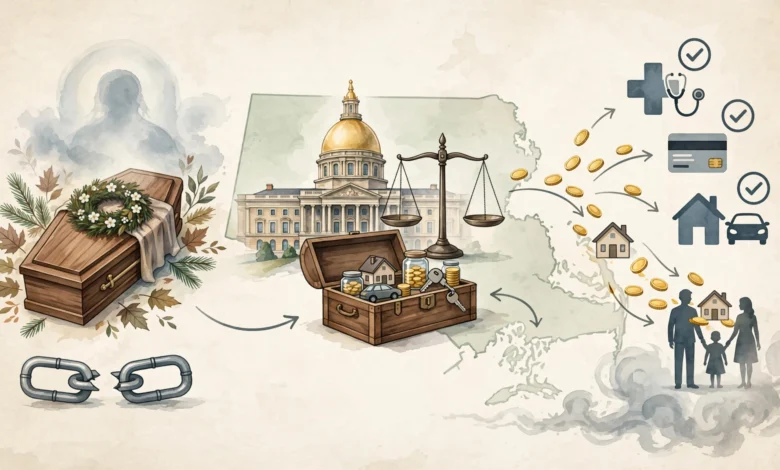
What happens to debt after death in Massachusetts is one of the first questions families ask once the funeral is over and the mail starts piling up. If your parent, spouse, or sibling passed away owing money on credit cards, a mortgage, or medical bills, you’re probably wondering whether that debt somehow becomes yours. It’s a fair worry, especially when a collection agency calls a week after the obituary runs.
The short version: your loved one’s debt after death in Massachusetts doesn’t vanish, but it also doesn’t automatically transfer to you. Instead, it becomes an obligation of the estate, the legal bucket that holds everything the person owned when they died. A court-supervised process called probate is where the sorting happens. The estate’s assets pay down what’s owed, following a specific order set by state law, and whatever is left (if anything) goes to the heirs.
But there are wrinkles. Joint debts, co-signed loans, MassHealth recovery claims, and a strict one-year deadline for creditors all shape how this plays out. This guide breaks down exactly how Massachusetts law handles a deceased person’s debt, who is and isn’t on the hook, and what steps to take if you’re suddenly the one managing an estate with bills attached to it.
Does Debt Disappear When Someone Dies in Massachusetts?
No. A common misconception is that debt simply evaporates at death. It doesn’t. What actually happens is that the debt shifts from being a personal obligation of the deceased to being a claim against their estate.
Here’s the practical distinction:
- The debt is real and collectible — creditors can still pursue payment.
- It’s collected from estate assets, not from your personal bank account.
- If the estate runs out of money, most unsecured debt simply goes unpaid, and creditors are generally out of luck.
This aligns with guidance from the Consumer Financial Protection Bureau, which explains that you’re generally not responsible for repaying a deceased person’s debt unless you were a co-signer, a joint account holder, or fall under a specific state exception. Massachusetts follows this general framework, with its own procedural rules layered on top.
How Massachusetts Probate Law Handles a Deceased Person’s Debt
When someone dies owning assets in their own name, those assets typically pass through probate, a court process that verifies the will (if there is one), appoints someone to manage the estate, and oversees the payment of debts before anything goes to beneficiaries.


The Role of the Personal Representative
The person appointed to manage the estate is called the personal representative (older documents may call this role “executor” or “administrator”). Their job includes:
- Locating and valuing estate assets
- Notifying creditors and the public of the death
- Reviewing and validating (or disputing) claims against the estate
- Paying valid debts in the legally required order
- Distributing whatever remains to heirs or beneficiaries
This role carries real responsibility. If a personal representative pays the wrong creditors out of order and the estate runs short, they can become personally liable to the creditors who should have been paid first. That’s one reason many families bring in a probate attorney rather than handling this alone.
Massachusetts General Laws Chapter 190B
Massachusetts probate procedure, including how debt after death is handled, is governed by the Massachusetts Uniform Probate Code, found in Massachusetts General Laws Chapter 190B. This statute lays out creditor deadlines, the payment hierarchy, and the protections available to a personal representative who follows the process correctly. Section 3-807, for example, protects a personal representative from personal liability if they pay debts in good faith after the required waiting period, as long as they had no notice of additional claims.
Are Family Members Responsible for a Deceased Relative’s Debt in Massachusetts?
This is usually the most urgent question, and the answer offers real relief to most families: generally, no. In Massachusetts, family members are not personally liable for a deceased relative’s debt simply because they’re related. Your parent’s credit card balance does not become your credit card balance.
There are, however, exceptions worth knowing.
Joint Debts and Co-Signed Loans
If you co-signed a loan or held a joint credit card account (not just an authorized-user card) with the deceased, you remain responsible for that balance. The debt was legally yours too, and death doesn’t change that. Authorized users, by contrast, are typically not liable, since they never agreed to repay the debt in the first place.
Massachusetts Is Not a Community Property State
Unlike states such as California or Texas, Massachusetts is not a community property state. That means a surviving spouse doesn’t automatically inherit their deceased spouse’s individual debts just by virtue of the marriage. Property that was jointly owned with rights of survivorship typically passes directly to the surviving owner and generally isn’t reachable by the deceased spouse’s creditors through probate.
Necessaries Statutes and Medical Bills
Massachusetts does have a “necessaries” doctrine in some circumstances, which can, in limited situations, make a spouse responsible for certain essential costs like medical care provided during the marriage. This is a narrower and more fact-specific exception, so anyone facing a bill framed this way should talk to an attorney before paying.
The Order Creditors Get Paid: Massachusetts Debt Priority Hierarchy
Not all creditors are equal in the eyes of Massachusetts probate law. If the estate doesn’t have enough money to pay everyone, state law dictates who gets paid first. In general terms, the priority order looks like this:
- Costs of administering the estate (court fees, personal representative expenses)
- Reasonable funeral and burial expenses
- Debts and taxes with federal priority, and certain family allowances for a surviving spouse and minor children
- Reasonable and necessary medical expenses of the final illness
- Other secured and unsecured debts, including credit cards, personal loans, and general medical bills not tied to the final illness
Secured debts, like a mortgage or an auto loan, work a little differently. The debt is tied to a specific piece of property, so if the estate can’t keep up payments, the lender can typically repossess or foreclose on that asset rather than waiting in line with everyone else.
Paying creditors out of this order isn’t just risky, it can expose the personal representative to personal liability if it leaves higher-priority creditors unpaid.
How Long Do Creditors Have to Collect Debt After Death in Massachusetts?
Massachusetts sets a notably strict deadline. Under Massachusetts General Laws Chapter 190B, Section 3-803, creditors generally have one year from the date of death to bring a formal claim against the estate. This is shorter than the two-plus years allowed in many other states.
A few details matter here:
- Simply filing a notice with the probate registry isn’t enough anymore; the creditor typically needs to pursue an actual claim within the one-year window.
- If a creditor misses the deadline, the claim is usually barred permanently, and they can’t pursue the estate or the family afterward.
- MassHealth is a major exception. Under Massachusetts case law (In the Matter of the Estate of Kendall, 486 Mass. 522), MassHealth has three years from the date of death to file estate recovery claims, not one.
Massachusetts also doesn’t require the personal representative to directly notify every known creditor by mail. Instead, the law generally requires publication of a notice in a local newspaper, which starts the clock running for the public at large.
What Happens to Different Types of Debt After Death
Not every kind of debt is treated the same way once someone passes. Here’s how the major categories typically play out under Massachusetts law.
Credit Card Debt
Credit card balances are unsecured debt. They get paid from estate assets after higher-priority claims like funeral costs and final medical expenses. If the estate runs dry before reaching credit card debt, the remaining balance is usually written off, and the card issuer generally cannot pursue family members who weren’t joint account holders.
Medical Debt and MassHealth Estate Recovery
Medical bills tied to the person’s final illness get elevated priority in the payment order. Other, non-final-illness medical debt is treated more like an ordinary unsecured claim. The bigger issue for many families is MassHealth estate recovery. If the deceased received MassHealth (Massachusetts’ Medicaid program) benefits, particularly for long-term care, the state can file a claim against the estate to recover what it paid out, and it has three years to do so rather than the standard one-year window.
Mortgages and Secured Debts
A mortgage doesn’t disappear because the borrower died. If heirs want to keep the home, they generally need to continue making payments or refinance the loan. If no one steps in, the lender can foreclose to satisfy the debt, but the family typically isn’t personally liable for any shortfall beyond the value of the property itself, unless they co-signed the loan.
Student Loans
Federal student loans are typically discharged upon the borrower’s death once the personal representative submits proof, so the estate isn’t on the hook for that balance. Private student loans are a different story: some private lenders may still attempt to collect from the estate, and if there was a co-signer, that person could remain responsible for the balance depending on the loan’s terms.
What If the Estate Doesn’t Have Enough Money to Pay Debts?
When a deceased person’s liabilities exceed their assets, the estate is considered insolvent. Massachusetts law allows the personal representative to formally represent the estate as insolvent to the probate court. Once that happens:
- Creditors are paid according to the statutory priority order until the money runs out
- Lower-priority creditors typically receive partial payment or nothing at all
- Beneficiaries named in the will generally receive nothing if debts consume the entire estate
- Family members are not required to make up the difference out of pocket
This is one of the more reassuring parts of Massachusetts probate law for grieving families: an insolvent estate is the creditors’ problem, not the heirs’.
Steps to Take When Handling a Deceased Loved One’s Debt
If you’ve been named personal representative, or you’re simply trying to help sort out a family member’s affairs, here’s a practical starting checklist:
- Get several certified copies of the death certificate. You’ll need these repeatedly for banks, creditors, and the probate court.
- Gather financial records — bank statements, credit card bills, loan documents, and any life insurance or retirement account paperwork.
- Don’t pay debts out of your own pocket before you understand whether you’re legally obligated to, or whether the estate even has enough to cover them.
- File a petition in the appropriate Massachusetts probate court to open the estate and get formally appointed.
- Notify Social Security, employers, and financial institutions of the death, and cancel or transfer joint accounts as needed.
- Review every creditor claim carefully before paying it. Not every bill that arrives is valid, and you’re entitled to question or dispute one that looks wrong.
- Talk to a Massachusetts probate attorney, particularly if the estate is insolvent, involves MassHealth recovery, or has disputes among heirs.
Protecting Yourself From Debt Collectors After a Death
Debt collectors sometimes contact family members even though the family isn’t legally responsible for the debt. Know your rights here. Under federal law, a collector generally can’t say or imply that you personally owe a deceased relative’s debt unless you actually co-signed it or hold a joint account. The Consumer Financial Protection Bureau confirms that collectors are permitted to discuss the debt with a surviving spouse, executor, or administrator, but they cannot pressure anyone else into paying it, and doing so can be a violation of federal debt collection law.
If a collector oversteps, you can send a written request telling them to stop contacting you, and you can dispute any debt you don’t believe is legitimate.
Planning Ahead: How to Limit Debt Burdens on Your Family
While Massachusetts law already shields most family members from personal liability, a little planning can make the probate process faster and less stressful for whoever ends up handling your estate:
- Keep a clear, updated list of debts, accounts, and creditors
- Consider whether life insurance could cover final expenses and outstanding secured debts
- Talk to an estate planning attorney about trusts, which can sometimes streamline how assets pass outside of probate
- Make sure beneficiary designations on retirement accounts and life insurance are current, since these assets typically bypass probate and creditor claims entirely
Conclusion
Debt after death in Massachusetts is handled through the estate and the probate process, not by passing the bill to surviving family members. The personal representative uses estate assets to pay valid creditor claims in a legally required order, funeral costs and final medical expenses first, followed by other debts, and creditors generally have just one year from the date of death to make a claim (three years for MassHealth). Family members are typically not personally liable for a deceased relative’s debt unless they co-signed a loan, held a joint account, or fall under a narrow legal exception. If the estate doesn’t have enough to cover everything, unpaid debt is usually written off rather than passed down. Given the strict deadlines and priority rules involved, anyone managing a Massachusetts estate with outstanding debt is well served by consulting a probate attorney early in the process.